
Eilen Jewell brings “Queen of the Minor Key” to The Soapbox
By Brian Tucker
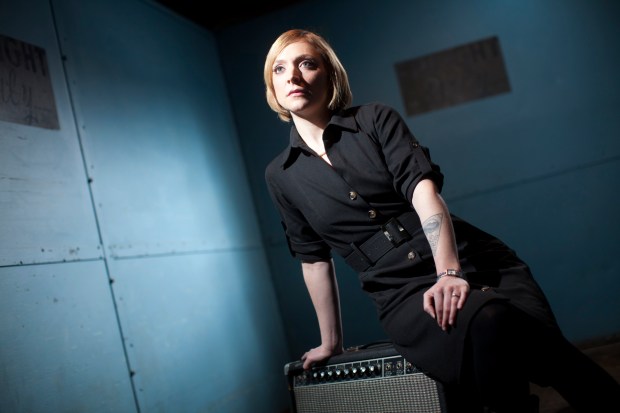
Eilen Jewell and her band make music that’s a car crash of country and rock and roll, notably from the 1950s. The singer-songwriter’s voice is a charmer, forthright and with hints of sultriness. On recent album Queen of the Minor Key Jewell and the band are firing on all cylinders.
Jewell’s music tends to be about looking back, nostalgia mixed with regret. Not just lyrically, the music feels very much alive, thick with slide guitar, elephant sized horn playing and Jewell’s voice that’s a smooth blend of Lucinda Williams, Patsy Cline, and echoes of a loving grandmother.
Surprisingly, given the personality and polish of Queen of the Minor Key (all of her albums are recorded live), Jewell didn’t instantly jump at being a performer. At an early age she was drawn to oldies stations playing music from the 50s and 60s and counts 1986’s Stand by Me soundtrack as a huge part of her musical upbringing.
“I’m not sure what it is about that era of music and earlier,” Jewell said. “Something about recorded music still being in its infancy. I wasn’t thinking this at the time. I’m just surmising what could be attractive about it to me. Since I could remember, when I sought out music that was what I looked for.”
The Boise, Idaho native attended Santa Fe College in New Mexico. She briefly performed at Farmer’s Markets and later moved to Venice Beach, California where she performed on the streets for a few months, getting on-the-job-training in how to deal with people.
“It was good because people that walked by taught me how to not take that personally. I had to develop a thick skin. The people who stopped really encouraged me and reinforced my decision to pursue my music. At that point it wasn’t a real solid decision. It was an experiment.”

Street performing, or busking, was her experiment. Jewell wasn’t sure playing music was her calling, still working against personal inhibitions about performing. Until moving to Boston she didn’t really get serious about playing music.
“I feel like people are born with a certainty about what they want to be. I never had that. I think once I released my first album things fell into place quickly since then. But to get to that point it seemed like it took a long time. There was a long period of searching for what my calling was and always ignoring music because I couldn’t see myself as a performer. It was a slow evolution to get that point of the first record. Once that happened things happened much faster than I thought it would.”
She’s been with the same band more or less since forming one in Boston and made music steadily since 2005. In between Eilen Jewell albums she recorded a gospel album with a band called The Sacred Shakers and in 2010 released an album covering Loretta Lynn songs. Jewell’s songs are scarcely autobiographical but her writing centers around longing and homesickness, something she’s well versed in after living eight years in Boston.
“I think possibly moving to the East has helped me gain an appreciation for the landscape and the lifestyle out West. I’m not sure I would have the appreciation if I hadn’t moved so far away from it. I love the Northeast but it’s made me fully appreciate where I come from.”
In songs her subjects are usually people from the West or the South, told through a musical tapestry of blues, 50s rock and country illustrating Big Sky Country, nostalgia, and themes such as regret.
“The characters I write about whether they’re like me or not they are kind of like me in a sense because they look back a lot on their lives. I see myself as being a realist. I feel like I write about what I know. I’m not sure about sentimental. I cant see myself as being a realist, I feel like write about what I know. I happen to know a lot about homesickness at this point in my life and that tends to be what I write about.”
More with Eilen Jewell
Did you study music theory at Santa Fe College?
I went to Santa Fe to study liberal arts. Music was part of that curricular for a year. I started studying music when I was taking piano lessons. I started by playing with friends at Farmer’s Markets in Santa Fe, street performance stuff and sitting in on friend’s gigs for a song or two. I was playing at that time mostly traditional blues and folk songs. Dylan and old bluegrass songs, traditional bluegrass songs by Bessie Smith I’d heard recording songs, Billie Holiday songs.
What’s a memory of playing around Venice Beach?
Some people walked by but a lot of people stopped listened really seemed intrigued with what I was doing. I got a lot of questions about how I was doing what I was doing. They were puzzled, they thought I had a recorded track I was playing to, they seemed to not believe that I was one person was playing the guitar. I was puzzled by how puzzled they were. I often got questions “how are you doing that?” well, I have a guitar and it’s plugged in an amplifier and I’m singing into a microphone.
Having your songs in a movie or television show, is it strange, especially if it’s used in contrast to what you wrote?
It’s still new to me to have songs on TV. It feels strange, it definitely does. It’s really exciting. I get a kick out of it. If anything else I find it kind of amusing to see where my songs end up. When I’m writing I don’t think about that. I think about them. It’s almost like a little child. You don’t know what kind of life it’s going to have. I think sometimes the placements have been a little surprising but it’s okay. I’m not super hung up that. I think that if people think it fits in the scene then who am I to say it doesn’t. (sons of anarchy). It is funny and surprising.
What are some of your musical interest that might surprise people?
I think a lot of people are surprised by the gospel thing because my original songs are kind of the opposite of gospel. They’re about forlorn characters and sort of lost souls. Gospel is all about being found, being in the light and a lot of positivity. At least we do in our gospel band. And they might also be surprised because a lot of people around me know I’m not religious. It’s something I do because it feels right.
A lot of people look at me with confused looks on their faces. A lot of people have preconceived notions about what gospel music is. What we do is probably different form they’re used to. We do the old traditional gospel music; we consider it to be traditional. Like Hank Williams gospel tunes and sound in 1920s, 30s, or 40s. So, not what you hear on the radio these days. We’ll do two gospel songs per show, or one. If we’re getting the feeling its not a gospel kind of crowd we wont do any. It’s a lot of fun but we don’t get to do it very often because we’re always touring with my band.
Do you record live?
We record in a live style, not a lot of isolation between instruments, kind of a mix. My vocals are usually isolated. We don’t use scratch tracks. We play everything live and try to get it in the first take or second take. We try to keep it as live as possible.
That’s how we’ve always done it. We have this philosophy – if isn’t broke don’t fix it.
The Stand By Me soundtrack album. What resonates about it?
I did love really that soundtrack. It was a huge part of my musical upbringing. I’m not sure what it is about that era of music 50’s 60’s and earlier, something about recorded music still being in its infancy. I think that what I’m trying to say there’s an innocence to the not only the production but to the style of singing is a part of it too. I think singers nowadays over sing, at least in my opinion, there’s a lot of overproduction, over singing. All I hear is the effort in modern music. There are definitely exceptions.
In the early music there’s innocence, the natural organic quality to what they used to do. I feel like over singing was much more rare. You couldn’t really over produce because the production was still fairly basic. I kind of miss that live style. The performance was really important back then. Now everything is post-production. You don’t have to have a good song. You don’t have to know the song. You can just dial it in with your computer. I like the sound of that natural, just the people playing their instruments.
It’s more sterile now. Everything’s more precise, and maybe more accurate, but not as soulful.


