
D&D Sluggers album release show at Soapbox

By Brian Tucker
Dustin Overcash, one half of D&D Sluggers, wants to be a celebrity at Bank of America, recognized not by its customers but the staff. Before moving to Wilmington, Overcash worked in Charlotte as an actor mostly doing industrial commercials and training videos for the national bank chain.
“Most of the time it was training films and I’m a bank teller. I’ve always wanted to walk into a Bank of America and be recognized,” Overcash said, adding that it was ultimately unrewarding. “Producers could be overbearing and directors asking you to be animated. But it was nice to work forty-five minutes and walk out with a $500 check.”
Overcash and a friend visited Wilmington for a weekend and decided to get an apartment. He was also involved in theatre and short films and even worked on a short film for a UNCW student before moving. At the time there were also auditions for One Tree Hill and driving ten minutes to them versus four hours form Charlotte was a plus. The theatre background works well with fellow D&D Slugger Tim White, has made for a fun, atmospheric band.
“The theater training is 95% of what I do in this band. It’s all about the show, not necessarily the spectacle because we’re not KISS or anything. It’s about confusing the hell out of people and having them, through the process of that show, try and figure out what you’re doing. They don’t understand it and I think that’s why people keep coming back. We both sing. Tim’s the primary singer and I do harmonies. 15% of the songs I sing lead on.”
Overcash and White were in their own respective bands (Little Miss Sabotage and the Cornflowers, soultron) until those projects dissipated. They met at 16 Taps downtown, both involved in the open mic circuit around town. They would form D&D Sluggers purposely to be fun and ridiculous.
“We’re goofs and we wanted to do something goofy,” Overcash said. “We were left with not much to do. Tim had this library of songs and we always talked about doing a band together but make it something ridiculous, like a cover band for a band in the style of another band.”
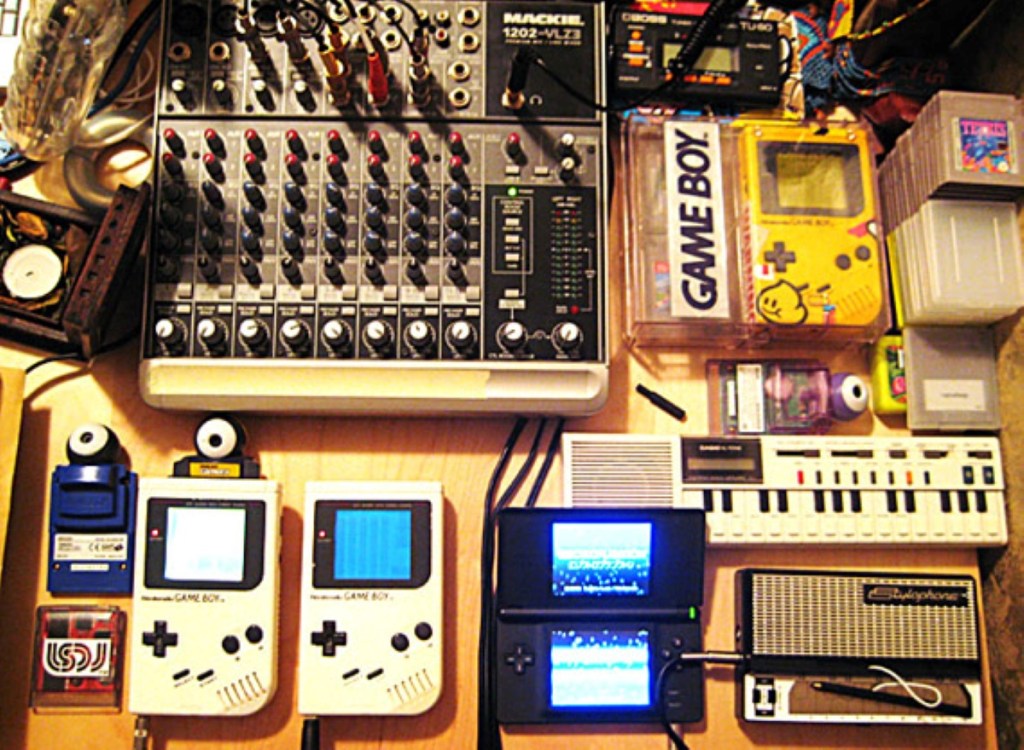
D&D Sluggers became a distillation of the duo’s band histories and the burgeoning style of creating music via old technology. D&D Sluggers is partly music made using Korg DS-10 software found in video game machines. A blend of dance, pop, and Nintendo – think of it as techno with velvety vocals and a proud helping of geek. Called chiptune, or chip music, it spawned from the bounty of abandoned game consoles that artists have put to use making music. Each computer or console has a unique sound and the music isn’t auto-tuned, it’s man-made, using the DS-10 as an instrument.
White found the Korg DS-10 software in a video on YouTube and realized it was a powerful tool that could replace a rhythm section. KORG DS-10 is a music creation program for the Nintendo DS emulating the Korg MS range of synthesizers. Within a day of messing around with it White had a song. Two days later he had another song. What they’re doing, like other chiptune musicians, is creating in the absence of major funding. (“As far as initial investment, going from square one for $200 you’re a chiptune musician).
In the 1970s poor kids used beat-up guitars (or stolen ones) to start punk bands. In the early 80s inner city kids made rap music looping beats from cassettes and vinyl. Similarly, D&D are making new music from something old. As its own community of music makers, chiptune has seen its share of blips on the radar. The Scott Pilgrim movie utilized chiptune for the film’s Universal Studios theme music and opening logo. There is also a 2009 Weezer tribute album free on the internet where the band’s songs have been rendered chiptune.
D&D’s music, at its core, are fun songs that are less novelty than a hearty spectrum of tastes – folk, dance, pop, industrial, techno, and rock. On the Fun is the Funnest! EP “Level Up” sounds like Steely Dan trying to be Nine Inch Nails. The fact that it contains gaming tones feels like an afterthought, another tool in making music.
D&D have attracted a following around town most likely because their music comes from a genuine, and to some degree, innocent place.
“Over its evolution what it’s become is making sure that we, and everyone watching or listening, are having a good time. Its party music but not the way a DJ would be party music. It’s not forcing you to party; it’s let’s have a good time.”
D&D Sluggers will have a CD release show at The Soapbox for This Album is a Party
w/Pretend Surprise and Black Hellatones
More with Dustin Overcash
How did you and Tim get together for D&D Sluggers?
Overcash: Tim and I were doing separate music projects. Tim was in soultron, his other pseudonym. We do a few that are D&D songs now. It was acoustic guitar, harmonica and soultron had a drummer, doing acoustic as hard as you could do it. Almost punk acoustic. I was in a folk group doing the guy-girl harmony thing, old school country.
We met because we were doing the open mic circuit around town. One night a group that did another open mic and we all became this band of friends. Tim played bass at a show for my previous band. We actually formed between his soultron, my group Little Miss Sabotage and the Cornflowers. Our friend Brandon O’Dell formed one super group to do two shows which was basically us playing all of our songs from all our bands but switching out instrumentation. Ttwo groups mated more or less.
And you built music for D&D using old video game tech?
Overcash: The way it works is the DS10 is a game cartridge for the DS and it was mass produced by Korg. You put it in and using the stylus on the screen you can set up your patches and make all the synthesizers that you want, lay them in, sequence them the way you want. Then you press a button and let it go when you’re ready. It’s the same as Little Sound DJ but less tedious.
Who discovered this?
Overcash: For Little Sound DJ Johan Kotlinsky in 2008 or 2009 decided he wanted to make a program that would allow him to do anything he can do with a Nintendo Game Boy sound chip. It’s easy enough to program that but the development kits don’t exist anymore because no one’s made a game for the Game Boy in years. He went in and back-ended it and created his own development kit in order to make Little Sound DJ. He comes out with a new version every few months. He sells it for $2 and a blank cartridge costs $35 and anyone you buy it from will put it on there for you as long as you have a license for it.
Taking a game’s software and using it to make music?
Overcash: To a certain extent. It’s not a pre-determined game. This is software that was built from scratch. It doesn’t piggy back off of anything. Now we’re using the Super Nintendo in lieu of the Game Boy which is just the Super Game Boy, just an easier way for us to port it over and it sounds better (using sounds that have already been preconfigured on the Game Boy).
Are there a lot of people doing it?
Overcash: It’s new but definitely growing. The chiptune community, as it is, its really exclusive in that you’re not chiptune if you’re aren’t working on original hardware. If you’re not programming it a certain way, if you’re using guitars and vocals. A lot of the actual chip tune community hates us – that we’re just playing with toys. But that’s the whole point, at least for us. Kids of the 80s and 90s now coming of age have decided that they don’t really care if they grow up or not. So, we’re going to Peter Pan it out and we’re still going to like video games. We’re going to like the games we grew up with we’re still going to play them and reference them and make them continually relevant.
I started out on the Sega master system, then, the original Nintendo. They’ve been in my life pretty much my entire life. I’ve always had that in some way or another. In some way you can almost lament having that much entertainment in your life. Looking back at your childhood, it was all spent on the couch but at least I’m not the only one, so I can’t feel entirely guilty about it.
Tell me about the band name.
Overcash: It was more or less arbitrary. The front runner at the time was Sweet Track Suit. Tim came to practice one day wearing a t-shirt that said D&D Sluggers on it, an old baseball shirt. This is my friend Ann’s old softball team when she was a kid, a recreation league team for a company called D&D Steelworks. In a way it really fits us. You have the Dungeon & Dragons (game) thing, if you connect it to D&D its got that very geek kind of feel to it then you have sluggers which sounds like you’re taking it seriously but you’re also kind of silly. It’s almost a perfect descriptor of what our band is. We’re geeks and we’re taking it seriously but we’re not taking it seriously.

 AVENUE