
The Del McCoury Band and The Preservation Hall Jazz Band
By Brian Tucker
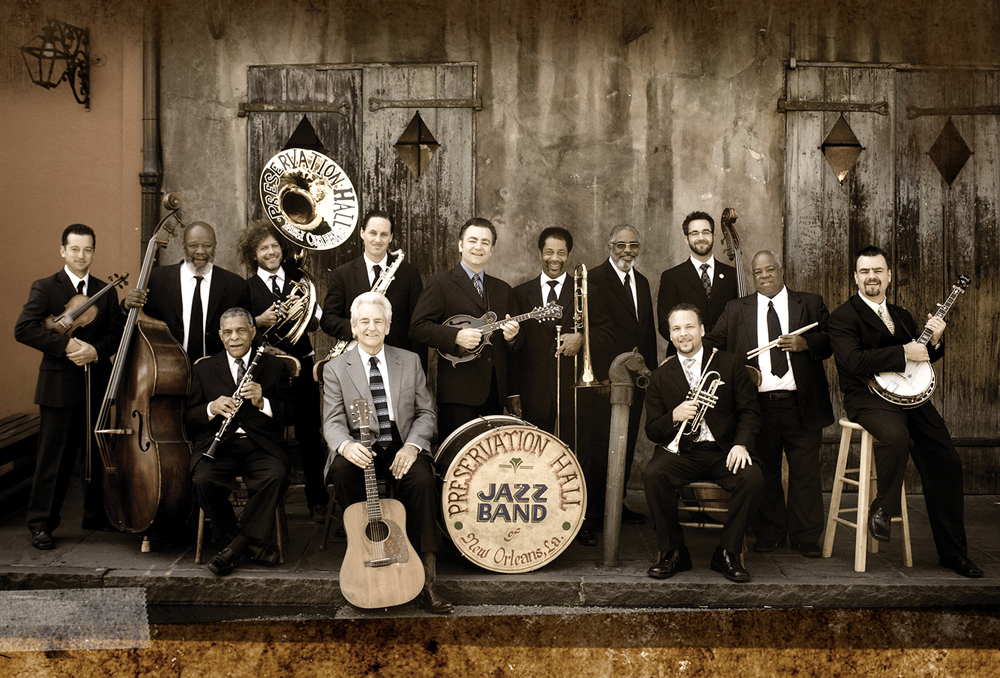
“I haven’t done an LP since the 80s,” Del McCoury said about pressing 500 vinyl records for a new album with the Preservation Hall Jazz Band, American Legacies, a beautiful marriage of bluegrass and jazz. McCoury’s band and Preservation Hall will perform at UNCW April 19th.
Hailing from Bakersville, North Carolina, McCoury’s conversation is filled with chuckles and charm, young at heart for someone who’s made music for fifty years. He’s played alongside the father of bluegrass, Bill Monroe, was inducted in the Grand Ole Opry, has his own label, his own festival (Del Fest), and his music has been covered by Phish.
At 72, McCoury’s seen the music business evolve almost since its beginnings. He’ll discuss Jerry Garcia (“he told me, I always wanted to be a bluegrass boy”), first hearing music on 78rpm records, and sitting around the radio with family listening to Monroe on the Grand Ole Opry.
His father and oldest brother listened every night and the brother taught him to play guitar. He heard Earl Scruggs play, who got his start playing bluegrass. After hearing Scruggs, McCoury switched to banjo for ten years (“from age 14 to about 24”) and was good at it. He was a banjo player until working with Monroe who needed a lead singer and a guitar player.
“I never (played) banjo after that. My first job with Monroe was playing banjo in New York City, my first time (there). He took me up there and I played banjo with him but he lead singer worse than anything. He found out I played guitar before. He said, if you make the grade doing that you’ll like it better. In the back of my mind I thought – no, I think you’re wrong, old man. Well, it worked out to where once I got my own band I would be playing the guitar and doing the majority of the singing and the emceeing. I thought, it would be better if I play rhythm guitar than play a lead instrument. So it worked out great.”
McCoury eventually formed his own band. He got married, raised a family, and his two sons Ryan and Ronnie play with him, something he accounts for his continued success.
“Family, they think a lot alike. My boys started so early in life they got good early. When they came in my band I could quickly go record anything. It’s easy to do a show or a record. You don’t have to rehearse as often.”
The album with Preservation Hall happened fortuitously. McCoury’s manager called with a request by Sony Red (his distributor) to sing with PHJB on a benefit record for musicians at Preservation Hall and Hurricane Katrina victims. He did and everyone had such a good time they decided to get both bands together and “see what it sounds like.” The fourteen songs on American Legacies were recorded in San Francisco, the whole a back and forth of bluegrass and jazz songs. The bands didn’t even rehearse before entering the studio. They played together, just like the live show, and sometimes a song will favor more bluegrass, and the next song will favor more jazz.
“We just got in there and somebody would say, hey, let’s do this tune. What key is it in? Those guys play in flats and sharps, a lot more than bluegrass people do which is kind of hard on the fiddle player. We’d say okay, lets try it. The way it is its all equal and its all pretty well balanced. Everything is.”
While he’s having a great time with the project and tour, the family has also been involved with a film about Bill Monroe. Ronnie met the film’s director, Finn Taylor, via Ryan who was teaching him mandolin lessons. They recorded six songs and The Black Keys’ Dan Auerbach recorded “Can’t You Hear Me Calling?”
“He told Ronnie he thought it might happen, might not, but wanted Ronnie to be the music producer,” McCoury said. “Evidently Dan’s a big fan of Mac Wiseman. We got him in the movie to sing this song Wiseman and Monroe recorded. Boy, he sang great, man. He’s a bluegrass singer at heart.”
Bluegrass resonates with young and old, the varied audience McCoury sees at their shows. He believes it’s because bluegrass isn’t easy to play and kids like a challenge.
“If you can play bluegrass you can go into any other band and play and probably be above any of the other musician’s level.”
More with Del McCoury
What are your memories of discovering music?
McCoury: My dad and oldest brother they listened to the Grand Ole Opry every night. I’m 72 and I can remember it before TV. Back then entertainment in a home was the radio. Bill Monroe was on the Grand Ole Opry, he joined in 1939. I was young. I really wouldn’t have noticed anything about him until the late 40s. He was hot then.
Do you feel you were a natural player when you started on the banjo?
McCoury: Yeah, I think it was. Of course, now it takes time for anybody to become good at what they do, but it was natural. I tell you what it comes back to, it comes back to if you are interested enough to keep it up and I was. Man, I just thought about music all the time. That’s all I thought about.
You went from listening to Monroe to go and playing for him.
McCoury: It was surreal. I tell you. It was such an exciting time and it was really something. I was just fortunate to do that. Jerry Garcia told me one time, ‘yeah I wanted to be a bluegrass boy.’ He was a banjo player, Garcia was. The first time I met Jerry I knew this guy David Grisman. He’s got a jazz band out in California now but he was an original bluegrass mandolin player. I played a bluegrass festival in northern Virginia and David was there. He introduced me to his new banjo player and it was Garcia. He had real thick black hair. He told me (he) always wanted to be a bluegrass boy and a lot of guys did. I just came along at the time he (Grisman) needed someone.
Of your fifty years playing what things stand out for you as a musician?
McCoury: My first big impression, the time that stands out, and when you’re a kid things really bowl you over, but when you get my age now nothing really excites in music (laughs). I hear it all. If I want to listen to a record, its funny, I still go back to that certain band that Bill Monroe with Lester Flat and Earl Scruggs in the band with Martin singing a duet with Bill. It was hard edge stuff. Today its pretty slick, everything is, but back then they were cutting some hardcore stuff and you don’t hear that today.
I think the Lord said, look if we’re going to have a bluegrass band let’s get Bill Monroe and Lester Flat to sing lead and play guitar Earl Scruggs to play the banjo and Chubby Weiss to play the fiddle. Bill knowing that a violin can do what a voice can do, it’ll sustain the notes and hold those notes out. He taught Chubby exactly what he was singing so Chubby did that on the fiddle and then you got that drive of that three finger roll on a banjo behind everything. The Lord knew what he was doing, I think. They set a pattern you can’t beat today. It’s just one of those things. That’s what I want to listen to.
Do you still feel young at heart? You sound like it.
McCoury: I think so. I enjoy it. The good part about being on the road and playing music is that 90 minutes you’re onstage. That’s the fun part of it all. There’s a lot of things you go through, flights cancelled on the road, but it’s all worth it when get out on the stage, entertaining and talking to the folks in the audience. I love that.
You moved to Nashville in the early 90s and became successful. Do you think you should have moved sooner?
McCoury: It’s funny how things go with each individual. I was here in ‘63 and played with Bill on the Opry and I was single then. Then I quit, got married, moved to California and played in a band called the Golden State Boys. They had a TV show, and then my wife she got so homesick. I didn’t know what homesickness was until I moved to California. I found out I had to move her back so I moved her back to Pennsylvania.
There was more work, actually more work, on the East Coast than there was West Coast then. So I stayed there and started having a family. I knew I had to get a day job because the pickings were pretty slim then. It’s a lot better today for any band or musician, more chances to get out play and book dates, but back then you had to play clubs mostly. There are more places to play now. Music is more widespread and it’s international now. I don’t do it anymore but I used to tour overseas but I quit that because there are too many great places in this country to play.
What was important that you learned from Bill Monroe?
McCoury: I imagine I learned a lot from Bill without even realizing it, about how to entertain folks and how to really do good onstage. I played a lot before I went with him. I was just playing mostly in clubs around Baltimore, small dates, and you don’t really think much about the big picture. I learned from him about how to play on a big show. He was playing big package shows with Grand Ole Opry acts.
He wasn’t the type of guy who said you do this like this, or sing this way, or you play this guitar run like this. He never was that type of guy. He just let you go. He let you do what you naturally do. I think that’s good too. I’ve been that way with people that’s been in my band for the most part because it gives a lot of variety in music. Each person has their own personality in their playing and that’s what makes it diverse. He didn’t tell Earl Scruggs how to play the banjo when he came in the band. Although he was just a kid, still in teens, and look what came out of that. He was from North Carolina.
What do you attribute to your success? Family? Playing from the heart?
McCoury: I really do. Family, they think a lot alike and because my boys started so early in life they got good early. As teenagers they were good musicians. When they came in my band, and once they did, I quickly go to record anything. We have the same interests in music. It’s just easy to do a show or a record; you don’t have to rehearse as often. These guys in my band they can play things I recorded 30, 40 years ago. They know it all, all that stuff. I never pushed them. When they were kids they were listening to southern rock, the Allman Brothers, it’s probably influenced their playing some.
What about changes over time in tech?
McCoury: I didn’t understand any of it. My wife she does the computer internet stuff. I just never did get into it. It’s really something. Back when I was learning you had a record player and if you wanted to learn something pick the needle up and play it over and over again. You couldn’t go see anybody play.
That’s part of the reason there’s more big musicians today than then because they can learn from the screen like an instructional video. They can watch people’s fingers play chords or whatever and it makes it a lot easier for them. So, they get good early. There are a lot of great young musicians and we have so many young people that come to our show. I think it’s because kids like a challenge and they know it’s a challenge to play these acoustic instruments. And boy, when they latch on to it look out, ‘cause they’re’ going to show you something.
Why do you think bluegrass music perseveres?
McCoury: It’s not an easy music to pay. If you can play bluegrass believe me you can go into any other band and play and probably be above any of the other musician’s level. There’s nobody that can play any other form of music like fast tunes and keep their chops up. I stress that with my boys because I tell you, they’ll get lazy (laughs). But you have to do it. I have some crackerjack musicians in my band. Hang on, then they take off. Then you’ve got your variety. You have to play that fast stuff so you can play the slow stuff so you have a variety in your show. Otherwise your show’s going to sound the same all the way through.
How did everyone decide on songs to record for American Legacies?
McCoury: It was real easy to select stuff. We’d go through it and somebody says, ‘now lets let the fiddle and clarinet play this part right here, they’re so similar.’ And its funny, the clarinet player is 80 and Jason is only about 30 and yet they really do well together. It fascinates their clarinet player, Charlie. He can play but he can’t play double notes. Jason he can play every thing they do in double style. Instead of just playing one melody note he’ll play a melody note with a harmony note with it. Jason is good at that.
It takes years but once you get to Jason’s age and played as long as he has its easy but he’s done it for so long. Charlie, its funny, he’ll be singing a song onstage and then he’ll take a clarinet break and then he’ll take the clarinet and point it right straight at Jason and Jason never played the break before and he’ll just take off on it.
We’re having a great time with this project. Those guys are great. Those guys can play those horns. We’re enjoying this because its so different for each one of us, for my band, and its so different for those guys to be playing too.
Is American Legacies available on vinyl?
McCoury: We pressed 500. But that’s great because you can put a picture of a band on there and it’s bigger. That’s the good part about those old LPs. That’s all we had back then. When I was growing up all we had was 78s. It came along about when I just starting to get good playing music in the 50s.
“50/50 Chance” is a McCoury original, correct?
McCoury: I came up with that years ago. I put it on a record one time. Ronnie said, why don’t you do that with these guys? He and Ben Jaffe from the jazz band produced it. I said, well, we’ll try it. I didn’t play guitar or nothing I just let those guys back me up.

 AVENUE